
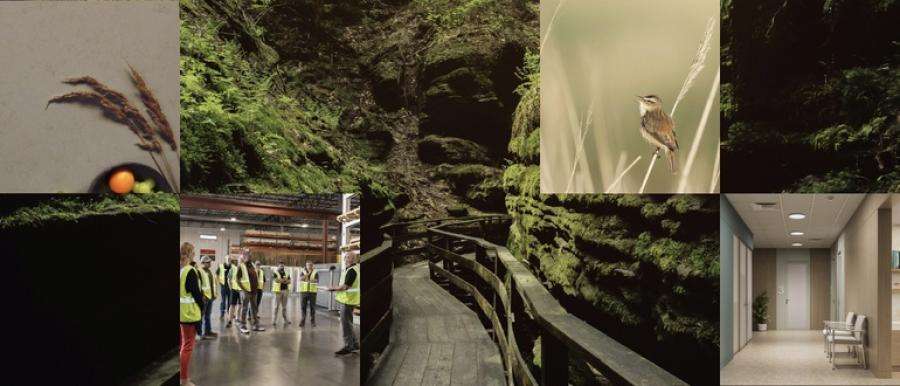
2025 Sustainability Report highlights progress in recycled content, manufacturing efficiency, product transparency, and carbon reporting
TEMPLE, Texas — Wilsonart is marking its 70th anniversary with a look at how its products and manufacturing operations are evolving alongside ways the brand can push itself even further in their continuous commitment to sustainability. The company’s 2025 Sustainability Report, Acting Beyond the Surface, covers progress in recycled content, waste reduction, resource efficiency, product transparency, and carbon reporting.
Wilsonart’s sustainability journey began in 1961, when founder Ralph Wilson Sr. introduced a 5-by-12-foot laminate press that allowed two standard kitchen countertops to be produced from a single sheet. The process improved manufacturing efficiency—and reduced material waste.
That focus on making better use of materials continues today.
“Sustainability is fundamental to our business. It shapes how we innovate, how we operate, and how we drive value,” said Andrew Korzen, President and CEO of Wilsonart. “As we look toward the next 70 years, we are continuing to challenge conventional thinking and find new ways to create products and processes that are better for our customers, our people, and the resources we share.”
More Recycled Content + Materials
In 2022, Wilsonart set a goal of reaching 40% post-consumer recycled content (PCRC) in High Pressure Laminate (HPL) by the end of 2027. Average PCRC in HPL increased from 23% in 2023 to 26% in 2025. As of 2026, the best-selling Type 335 HPL contains 36% PCRC. The company is expanding its network of recycled paper suppliers and increasing recycled content in other top-selling HPL products.
But recycled materials are only part of the equation—manufacturing facilities are also finding ways to put waste to use.
At the Fletcher, North Carolina facility, sander dust from laminate production is used to create process heat. The process has reduced waste sent to landfills by more than one-third. A similar process was successfully introduced at the Temple, Texas facility in 2025.
Temple also has a system that captures vaporized methyl methacrylate (MMA) from Solid Surface manufacturing and converts it back into reusable liquid material. The process reclaims approximately 740 gallons of MMA each year, diverting more than 6,000 pounds from hazardous waste streams and reducing waste disposal costs by more than $88,600.
In 2025, Wilsonart launched bonus program at its Fletcher and Temple HPL manufacturing sites. Employees are encouraged to identify ways to reduce scrap and material waste and improve operational efficiency. The goal is to give everyone within the company a direct role in finding and addressing waste in the manufacturing process.
Easier to Find Product Information
Architects and designers increasingly need detailed information about the products they specify. Wilsonart continues to expand its Environmental Product Declaration (EPD) portfolio, which provides lifecycle information from material sourcing through disposal and is verified by SCS Global Services. Other available documentation includes Declare labels, Health Product Declarations (HPDs), and indoor air quality certifications.
In July 2025, Wilsonart partnered with Ecomedes to make this information easier to access. The platform brings together EPDs, Declare labels, HPDs, and information supporting green-building standards.
Three products have earned USDA BioPreferred certification: HPL with 70% biobased content, Compact with 71% and Thinscape with 65%.
Carbon reporting has also expanded. Scope 1 and Scope 2 emissions have been measured annually since 2022. In 2025, Wilsonart began evaluating certain global Scope 3 emissions and obtained limited third-party assurance over its Scope 1 and Scope 2 emissions data.
Water use is another area of focus. At Wilsonart’s Polyrey facility in France, a 2024 cooling system redesign reduced water drawn from the La Sarsonne River by approximately 98% and stopped the return of warm water to the river.
Looking Ahead
The 2025 report documents progress, but Wilsonart’s sustainability targets go far beyond the reporting cycle. The company is continuing toward its 40% PCRC goal for HPL while working to reduce waste, improve resource efficiency, expand product documentation, and better understand its carbon impacts.
“Sustainability is not something that sits on the surface of a business. It is embedded in the decisions underneath it,” said Kate Grossman, Vice President of Marketing and Design at Wilsonart. “In the materials selected, the processes developed, the resources recovered, the information shared, and the questions asked before the next product is ever made. The more we listen, the more we learn, and what was first seen as a challenge become an opportunity to innovate.” View our 2025 Sustainability Report.
# # #
About Wilsonart
Founded in 1956, Wilsonart is a world-leading engineered surfaces company driven by a mission to create surfaces people love, with service they can count on, delivered by people who care. Our company is headquartered in Austin, Texas, USA, with operations in the Americas and Europe. We manufacture and distribute High Pressure Laminate (HPL), Coordinated Thermally Fused Laminate (TFL) and Edgeband, Adhesives, Compact Laminate, Composite Countertops, Quartz, Solid Surface, Epoxy, Waterproof Wall Panels, and other decorative engineered surfaces for use in the office, education, healthcare, hospitality, retail, and residential markets. Operating under the Wilsonart®, Arborite®, Bushboard, Durcon®, KML, Laminart®, Mermaid™, Polyrey®, Ralph Wilson®, Resopal®, Shore®, Technistone®, Thinscape® and Wetwall™ brands, we continuously redefine decorative surfaces through award-winning design, performance, service and sustainability. For more information, visit wilsonart.com.
Validate your login
Sign In
Create New Account